23 December
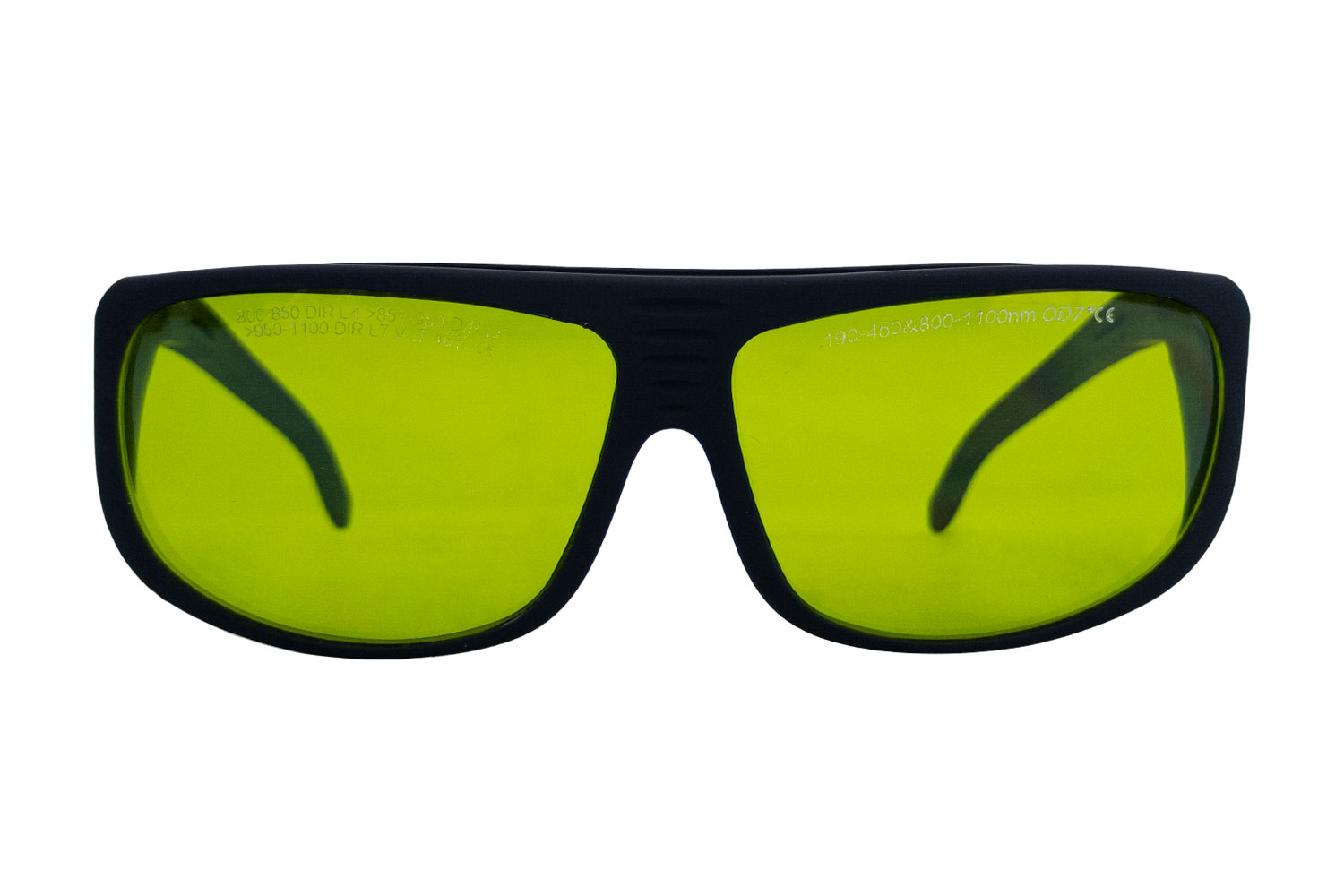
Safety glasses for laser welding and laser cleaning
Safety glasses for laser welding and laser cleaning
In a room where a Class 4 laser is used, wearing laser safety glasses is mandatory. Since laser light does not diverge, the intensity of the laser beam remains dangerous to the eye even over long distances.
Laser light and reflections
Direct exposure of the eye to the laser welding system is virtually impossible under normal circumstances. During welding, only part of the laser light is absorbed and converted into heat. Another part of the light is reflected. Depending on the surface and the type of material, this reflection can be specular or diffuse. In both cases, the risk of eye damage remains. Wearing laser safety glasses is therefore required and mandatory at all times in the vicinity of a laser welding machine.
Selection of laser safety glasses
Laser safety glasses are specifically designed for a particular type of laser. Not all glasses are suitable for every type of laser light. When selecting the right laser safety glasses…
- Laser type / laser mode
- Laser power / required attenuation level
- Laser wavelength
Laser type / laser mode
The pulse duration is important for the intensity of the laser and plays an important role in selecting the correct laser safety glasses. The classification is shown in the table below. For laser welding, we always assume D or I.
Letter
Pulse duration
Continuous Wave
D
>0,25s
Pulsed
I
1µs – 0,25s
Giant Pulsed
R
1 ns – 1µs
Mode-Locked
M
< 1µs
The attenuation level of the laser safety glasses is indicated by the LB or OD value stated on the glasses. NEN-EN 207 specifies that the protective value of the glasses must apply to both the lens and the frame. This concerns the LB value indicated on the glasses. The OD value (Optical Density) indicates the attenuation level of the lens.
Attenuation level
The attenuation level of the laser safety glasses is indicated by the LB or OD value stated on the glasses. NEN-EN 207 specifies that the protective value of the glasses must apply to both the lens and the frame. This concerns the LB value indicated on the glasses. The OD value (Optical Density) indicates the attenuation level of the lens.In some cases, the OD value is higher than the stated LB value. In this case, the lens in the frame has a higher protective value than the frame its
Power attenuation
Power transmission
OD1
0
100%
OD1
1/10
10%
OD2
1/100
1%
OD3
1/1000
0,1%
OD4
1/10.000
0,001%
OD5
1/100.000
0,0001%
OD6
1/1.000.000
0,000001%
OD7
1/10.000.000
0,0000001%
OD8
1/100.000.000
0,00000001%
OD9
1/1.000.000.000
0,000000001%
Wavelength
Different materials absorb light colours or wavelengths to varying degrees. This also applies to the materials used in laser safety glasses. For this reason, the glasses must indicate which attenuation level applies to a specific wavelength.Laser safety glasses often provide protection against a specific wavelength range of light. The glasses therefore indicate the wavelength for which they provide protection.An example of how the marking is shown on laser safety glasses is:800–1100 nm DIR LB5In this case, the laser safety glasses provide protection within the wavelength range of 800 to 1100 nm. This protection applies to lasers that operate with a pulse duration between 1 nanosecond and 0.25 seconds.
Light transmission of the glasses
Laser safety products do not use the colour codes known from traditional welding technology. The DIN colour codes from 7 to 13 cannot be converted into values used for laser safety products. For all laser safety products, such as glasses and protective glass, the value for visible light transmission is also indicated. This value shows the extent to which visible light passes through the laser safety glasses. A higher value therefore means that more light is transmitted than with a lower value.
Deel dit bericht